
Choosing the right Medical Bowls and Trays from China requires more than comparing prices or product photographs. These items support fluid handling, instrument organization, specimen collection, and bedside hygiene. A weak material choice can create spills, staining, sharp edges, or difficult cleaning. Small design failures matter.
The World Health Organization reports that about one in ten patients experiences harm during healthcare, while more than half of harm in primary and ambulatory care is considered preventable. This evidence makes practical infection-control details important. Buyers should examine stainless-steel grades, medical plastics, surface finishes, drainage design, stackability, and packaging protection. They should also request production samples, material certificates, sterilization information, and traceability records. ISO 13485:2016 provides a recognized framework for medical-device quality management, although certification alone does not prove that every bowl or tray suits a specific clinical use.
China offers broad manufacturing capacity, including precision stamping, injection molding, polishing, and customized packaging. However, supplier capability varies between factories. A polished tray may still have uneven corners. A lightweight bowl may crack after repeated thermal exposure. These details are easy to miss online.
This guide compares leading Medical Bowls and Trays from China through safety, durability, usability, documentation, and total cost. It considers hospital workflows, cleaning routines, and procurement risks. No supplier ranking is perfect. Real-world testing remains essential. A careful buyer should verify performance before placing a large order, because attractive specifications can hide practical weaknesses.
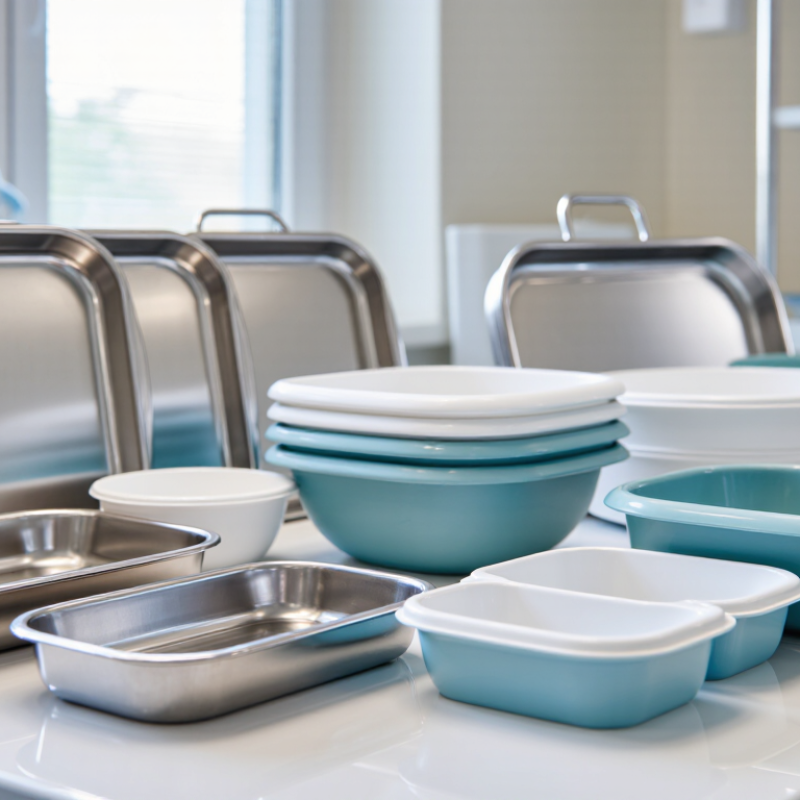
China produces a broad range of medical bowls and trays for hospitals, clinics, laboratories, and care facilities. Common types include stainless steel kidney basins, emesis bowls, dressing bowls, solution basins, and instrument trays. Their curved edges help contain fluids and reduce splashing during treatment. Some trays include fitted lids, handles, or perforated inserts for cleaning and sterilization.
Stainless steel models are often made from 304 or 316L material, depending on corrosion resistance requirements. A well-finished bowl should have smooth welds, rounded corners, and no sharp polishing marks. Plastic and pulp options are also available for single-use procedures. These products can reduce cleaning workloads, but buyers should verify material safety and disposal requirements before ordering.
Small details matter. Ask manufacturers for dimensional drawings, material certificates, and batch traceability records. Check whether lids close evenly and whether tray handles remain stable under load. Production quality can vary between factories, even when product photos look identical. A polished surface does not always prove reliable manufacturing. In my view, sample testing remains essential, especially for leak resistance, stacking stability, sterilization performance, and packaging strength. Some specifications may still miss practical problems, such as a basin that is difficult to grip with wet gloves.
| Product Type | Common Material | Typical Size Range | Common Shape or Design | Typical Medical Applications | Main Advantages | Cleaning and Sterilization Considerations | Commonly Requested Quality Requirements |
|---|---|---|---|---|---|---|---|
| Stainless Steel Round Bowl | Stainless steel, commonly grade 304; grade 316L may be selected for higher corrosion resistance | Diameter: 100–300 mm Depth: 40–100 mm |
Seamless or welded circular bowl with a rolled rim | Solution preparation, sponge soaking, general clinical procedures, and laboratory use | Reusable, corrosion resistant, durable, and easy to inspect for cleanliness | Suitable for routine washing and commonly compatible with steam sterilization when the product design and facility cycle permit | Uniform wall thickness, smooth inner surface, rounded rim, stable base, and no sharp edges |
| Kidney-Shaped Emesis Basin | Stainless steel, polypropylene, or other medical-grade plastic | Length: 250–450 mm Width: 120–220 mm Depth: 40–80 mm |
Curved kidney profile designed to fit close to the patient's body | Collecting fluids during vomiting, wound care, oral care, and minor bedside procedures | Contoured edge, easy handling, and convenient bedside placement | Reusable metal versions can generally be cleaned and sterilized; disposable plastic versions are intended for single use unless specifically validated otherwise | Leak resistance, smooth edges, adequate rigidity, stable shape, and clearly defined reusable or single-use status |
| Stainless Steel Dressing Bowl | Stainless steel 304 or equivalent corrosion-resistant stainless steel | Capacity: approximately 0.5–3.0 L Diameter: 120–260 mm |
Deep round bowl with a wide opening and reinforced rim | Holding dressings, gauze, antiseptic solutions, and small clinical materials | Good chemical resistance, long service life, and simple open access | Should be emptied, rinsed, washed, and dried after use; steam sterilization may be used according to validated institutional procedures | Low surface roughness, smooth welds, non-porous surface, dimensional consistency, and resistance to staining |
| Instrument Tray with Lid | Stainless steel 304 or 316L; optional silicone or polymer accessories | Length: 250–600 mm Width: 150–400 mm Height: 40–150 mm |
Rectangular tray with fitted or hinged lid and rounded corners | Transporting, organizing, and protecting surgical or dental instruments | Protects contents from handling damage and supports organized instrument processing | Tray, lid, and accessories should be cleaned separately; perforated versions can support steam penetration when designed for sterilization | Secure lid fit, smooth corners, stackability, corrosion resistance, drainage design, and compatibility with the intended sterilization method |
| Perforated Sterilization Tray | Stainless steel 304 or 316L | Common footprint range: 200 × 150 mm to 600 × 400 mm Height: 30–150 mm |
Perforated base and sides, often with handles or a removable lid | Loading, processing, and transporting reusable surgical instruments | Supports drainage, air removal, and exposure to sterilizing agents when properly designed | Perforations must remain unobstructed; the tray should be inspected for residue, deformation, and corrosion after each processing cycle | Appropriate perforation pattern, rounded openings, load-bearing strength, stackability, and validated sterilization compatibility |
| Instrument Transfer Tray | Stainless steel 304, anodized aluminum, or medical-grade polymer | Length: 300–700 mm Width: 200–450 mm Height: 30–100 mm |
Flat or shallow rectangular tray with handles or grip areas | Moving instruments between preparation areas, procedure rooms, and sterile processing zones | Improves organization and reduces direct handling of instruments | Material and surface finish should tolerate the facility's detergents and disinfection process | Load capacity, ergonomic handles, rounded corners, anti-slip options, and clear identification areas |
| Disposable Plastic Medical Bowl | Polypropylene, polyethylene, or other suitable medical-grade thermoplastic | Capacity: approximately 250 mL–5 L | Lightweight round, oval, or kidney-shaped bowl | Single-use fluid collection, dressing procedures, specimen handling, and bedside care | Lightweight, convenient, and reduces reprocessing requirements | Normally intended for single use and disposal according to the healthcare facility's waste procedures; do not assume reusability without validation | Leak resistance, adequate rigidity, smooth edges, material traceability, and suitable packaging cleanliness |
| Specimen Collection Tray | Stainless steel, polypropylene, ABS, or other suitable medical-grade plastic | Length: 200–500 mm Width: 120–350 mm Depth: 30–100 mm |
Shallow tray with compartments, raised edges, or removable inserts | Organizing specimen containers, swabs, labels, and collection accessories | Helps prevent spills and keeps related collection items together | Should be compatible with the laboratory or clinical disinfection process; removable inserts simplify cleaning | Compartment accuracy, spill control, chemical resistance, smooth surfaces, and secure container support |
| Dental Instrument Tray | Stainless steel 304, anodized aluminum, or high-temperature polymer | Length: 180–400 mm Width: 120–300 mm Height: 20–80 mm |
Compact shallow tray with rounded corners and optional silicone mat | Dental examinations, restorative procedures, oral surgery, and instrument setup | Compact footprint, organized layout, and compatibility with dental workstations | Silicone mats and inserts should be removed and processed according to their own instructions; tray materials should tolerate validated cleaning and sterilization cycles | Stable base, corrosion resistance, smooth welds, accessory retention, and compatibility with dental sterilization workflows |
| Anesthesia or Procedure Tray | Stainless steel, aluminum, or medical-grade polymer | Length: 300–700 mm Width: 200–450 mm Height: 50–150 mm |
Multi-compartment rectangular tray with raised perimeter and optional dividers | Arranging syringes, airway accessories, dressings, and other procedure supplies | Supports fast preparation and visual organization of frequently used items | Compartments should be easy to access and clean; disposable liners may be used where permitted by facility policy | Strong handles, non-slip surface options, compartment customization, easy disinfection, and adequate load capacity |
| Sterile Dressing Tray | Stainless steel, medical-grade polypropylene, or paperboard and plastic packaging components for single-use sets | Length: 200–500 mm Width: 150–350 mm Height: 30–100 mm |
Shallow tray or preassembled compartmentalized set | Wound dressing, minor procedures, catheter care, and bedside treatment | Provides an organized workspace and can be supplied as a reusable tray or a single-use procedure set | Reusable versions require validated cleaning and sterilization; single-use versions require controlled packaging integrity and disposal | Clear contents list, sterile barrier integrity where applicable, secure packaging, smooth surfaces, and reliable dimensional fit |
| Stackable Utility Tray | Stainless steel, aluminum, polypropylene, or ABS | Length: 250–600 mm Width: 150–400 mm Height: 40–150 mm |
Open rectangular tray with nesting feet, stacking rims, or interlocking corners | Storage and transport of medical supplies, small equipment, and packaged materials | Saves storage space and supports efficient handling in hospitals and clinics | Stacking surfaces should not trap soil; the selected material must be compatible with detergents and disinfectants used by the facility | Stable stacking, load capacity, dimensional consistency, smooth edges, corrosion resistance, and easy identification |
Begin with the clinical task. A specimen bowl, dressing tray, and instrument tray have different handling demands. Check smooth edges, stable bases, and corners that do not trap residue. Inspect the surface after cleaning. Small defects matter.
Test the rim, lid, base, handles, and stacking fit. A flexible lid may weaken handling. A thin base can bend under instruments. “Lightweight” is not always better.
Request written material specifications and temperature limits. Stainless steel should resist corrosion. Medical-grade polymers must tolerate the stated cleaning method. Do not assume repeated heat cycles are safe.
Ask for test reports, dimensional tolerances, and material certificates. Request packaging specifications and sample inspection records. For sterile items, review sterilization validation and package integrity testing. Documents should match the actual configuration.
Inspect seals, lot identification, and packaging condition. Look for crushed corners or broken seals. Labels must remain readable after handling. Small packaging defects can affect confidence.
Review batch records, traceability procedures, and corrective-action history. Request samples from different production lots. One perfect sample proves very little. Clear answers often indicate stronger process control.
No. A polished visit is not sufficient. Check storage cleanliness, labeling consistency, and production records. Confirm minimum order quantities, tooling ownership, and delivery history in writing. I once trusted attractive samples too quickly. That judgment needed correction.
Test drainage, grip, stacking, storage space, and loaded strength. Use the products in a realistic clinical workflow. Independent inspection can clarify cleanliness and mechanical performance. Repeat testing after user feedback. Conditions change.
China offers a broad range of Medical Bowls and Trays for hospitals, clinics, laboratories, and caregiving environments. Common options include emesis bowls, instrument trays, dressing trays, kidney-shaped basins, specimen containers, and specialized procedure trays. Buyers should consider materials such as stainless steel, medical-grade plastic, and disposable nonwoven compounds, focusing on durability, chemical resistance, ease of cleaning, and compatibility with sterilization methods. Products should be manufactured under consistent quality systems and meet applicable medical safety, hygiene, and performance requirements.
When evaluating suppliers, review product specifications, manufacturing capabilities, inspection procedures, and documentation. Customization may include dimensions, shapes, surface finishes, markings, packaging formats, and private labeling. It is also important to confirm whether items support steam sterilization, low-temperature sterilization, or single-use applications. Reliable suppliers should provide secure packaging, clear traceability, stable production capacity, and responsive communication. Comparing samples, certifications, lead times, and total purchasing costs can help buyers select suitable Medical Bowls and Trays for their intended use.