ASTM F1671 Viral Barrier
Zero viral penetration at 2 psi (13.8 kPa) hydrostatic pressure utilizing Phi-X174 bacteriophage challenge tests.


A comprehensive analysis of ASTM F1671 viral penetration resistance, thermal comfort innovations, global regulatory compliance (EU MDR & US FDA), and strategic OEM procurement trends for healthcare purchasing leaders.
Zero viral penetration at 2 psi (13.8 kPa) hydrostatic pressure utilizing Phi-X174 bacteriophage challenge tests.
Advanced microporous lamination allows high moisture vapor transfer while maintaining 100% liquid impermeability.
Full CE certification under EU MDR 2017/745 (obtained 2024), ISO 13485:2016 cleanroom manufacturing, and US FDA compliance.
In high-risk surgical disciplines—such as total hip/knee arthroplasty, cardiovascular bypass, organ transplantation, and emergency trauma resuscitation—the surgical team operates under continuous threat of high-volume blood splatters, pressurized body fluid irrigation, and viral pathogen exposure. ANSI/AAMI PB70 establishes the industry gold standard for liquid barrier performance in protective apparel.
While AAMI Levels 1 through 3 evaluate water resistance through impact penetration (AATCC 42) and hydrostatic pressure tests (AATCC 127 up to 50 cm H₂O), AAMI Level 4 requires complete liquid impermeability and viral barrier validation.
To qualify as Level 4, every material component and physical seam across the gown's designated Critical Zones must successfully pass two rigorous, standardized laboratory challenge protocols:
ANSI/AAMI PB70 explicitly defines the critical safety zones of a surgical gown that must maintain Level 4 protection during operative use:
| Standard / Parameter | AAMI PB70 Level 3 | AAMI PB70 Level 4 | EN 13795-1 High Performance |
|---|---|---|---|
| Primary Target Application | General Surgery, ENT, Urology | Orthopedic, Trauma, Cardiac, High Fluid | High Fluid & High Stress OR Environment |
| Water Resistance (AATCC 127) | ≥ 50 cm H₂O Hydrostatic Pressure | Passed as Baseline Requirements | ≥ 100 cm H₂O Hydrostatic Pressure |
| Synthetic Blood Barrier (ASTM F1670) | Not Required / May Fail under pressure | Pass (0 Pass-Through @ 2 psi) | Equivalent Liquid Penetration Protocol |
| Viral Penetration Resistance (ASTM F1671) | No Viral Testing Required | Pass (Zero Phi-X174 Penetration) | ISO 22610 / ISO 22612 Wet/Dry Microbial Pass |
| Seam Construction Standard | Standard Stitched or Bonded | Hermetically Sealed / Ultrasonic Welded | High Tensile & Burst Strength Seams |
| Linting & Cleanliness (EN ISO 9073-10) | Standard Non-Woven Rating | Ultra-Low Linting (Log10 Count < 2.3) | Strict Particulate Release Control |
Developed specifically for clinical personnel undergoing rigorous extended surgical procedures, Surgeine Healthcare produces three distinct AAMI Level 4 gown architectures designed to balance fluid defense, ergonomically refined fit, and heat vapor dissipation.
Constructed with a 68 GSM trilaminate monolithic PE membrane. Features 100% fluid-proof coverage across both critical and non-critical zones with raglan sleeve design and ultrasonic seamless sleeve joins.
Full Spec Sheet • ISO 13485 CertifiedCombines a microporous Level 4 viral barrier across front chest and sleeves with an ultra-breathable 5-layer SMS back panel to accelerate heat evacuation during 4+ hour surgeries.
Full Spec Sheet • CE EU MDR CompliantDesigned for heavy fluid loads during arthroplasty and joint replacements. Features chest-to-knee reinforced fluid channels, extended knitted moisture-repellent cuffs, and integrated fluid collection pouch clips.
Full Spec Sheet • Custom OEM BrandingUnlike traditional porous film coatings that degrade when exposed to alcohol, blood lipids, or scrub solution detergents, Surgeine's AAMI Level 4 barrier utilizes a monolithic hydrophilic membrane system. The solid elastomeric film allows water vapor molecules to diffuse through solid-state molecular transfer while creating an impenetrable wall against liquid water, blood-borne pathogens, and airborne bio-aerosols.
A surgical gown is only as strong as its weakest seam. Standard needle stitching creates tens of thousands of microscopic perforations through protective layers. Under pressure, fluids wick along sewing threads directly to the clinician's skin.
Healthcare purchasing directors, hospital materials managers, and global medical supply distributors face unprecedented market shifts driven by stringent regulatory overhauls, supply chain re-shoring, and heightened focus on clinician occupational safety.
Historic Level 4 gowns relied on non-breathable plastic film laminates that caused severe heat stress, sweating, and fatigue during long operations. The global market is rapidly phasing out non-porous films in favor of monolithic microporous breathable membranes that deliver thermal comfort without compromising ASTM F1671 viral protection.
The European Union Medical Device Regulation (EU MDR) has eliminated self-declaration shortcuts for sterile protective apparel. Global procurement bodies now mandate audited technical documentation, clinical evaluations, and Notified Body approval. Suppliers lacking MDR certification face exclusion from European public tenders.
Post-pandemic procurement strategies prioritize sourcing from established multi-facility manufacturers with integrated vertical production. Hospital procurement networks are diversifying away from single-region dependency by building direct partnerships with accredited Indian manufacturing leaders like Surgeine Healthcare.
With medical waste under global environmental scrutiny, hospital purchasing committees favor manufacturers utilizing right-sized fabric patterns, energy-efficient ultrasonic bonding, and clean polypropylene formulations that yield low-carbon incineration residue free of dioxins or heavy metals.
Hospitals are shifting away from buying standalone sterile gown packs. Modern ORs mandate the inclusion of facility-customized AAMI Level 4 gowns directly inside Procedure Packs (CPTKs) alongside specialized drapes and CHG prep kits to eliminate outer wrap waste and reduce room setup times by up to 40%.
Leading hospital systems evaluate disposable surgical gowns based on Total Cost of Ownership—factoring in surgical site infection (SSI) mitigation, clinician retention/comfort, packaging footprint, and shelf-life stability—rather than per-unit purchase price alone.
Founded in 2002, Surgeine Healthcare has spent over two decades focused on a single mission: engineering zero-defect sterile barrier solutions for the operating theatre. Operating across four state-of-the-art manufacturing plants, Surgeine stands as a premier Indian exporter of infection prevention disposables.
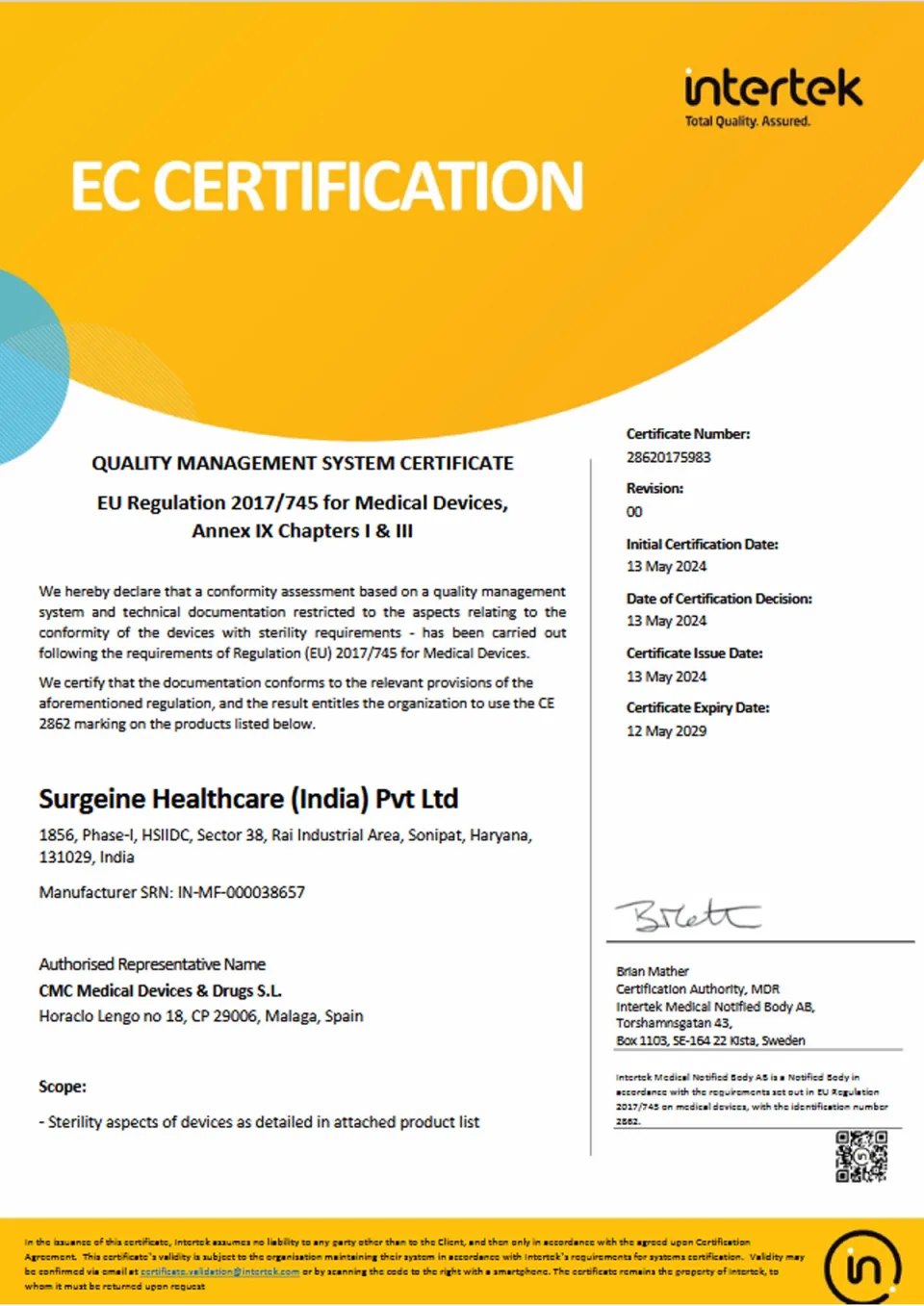 CE Certificate (EU MDR)
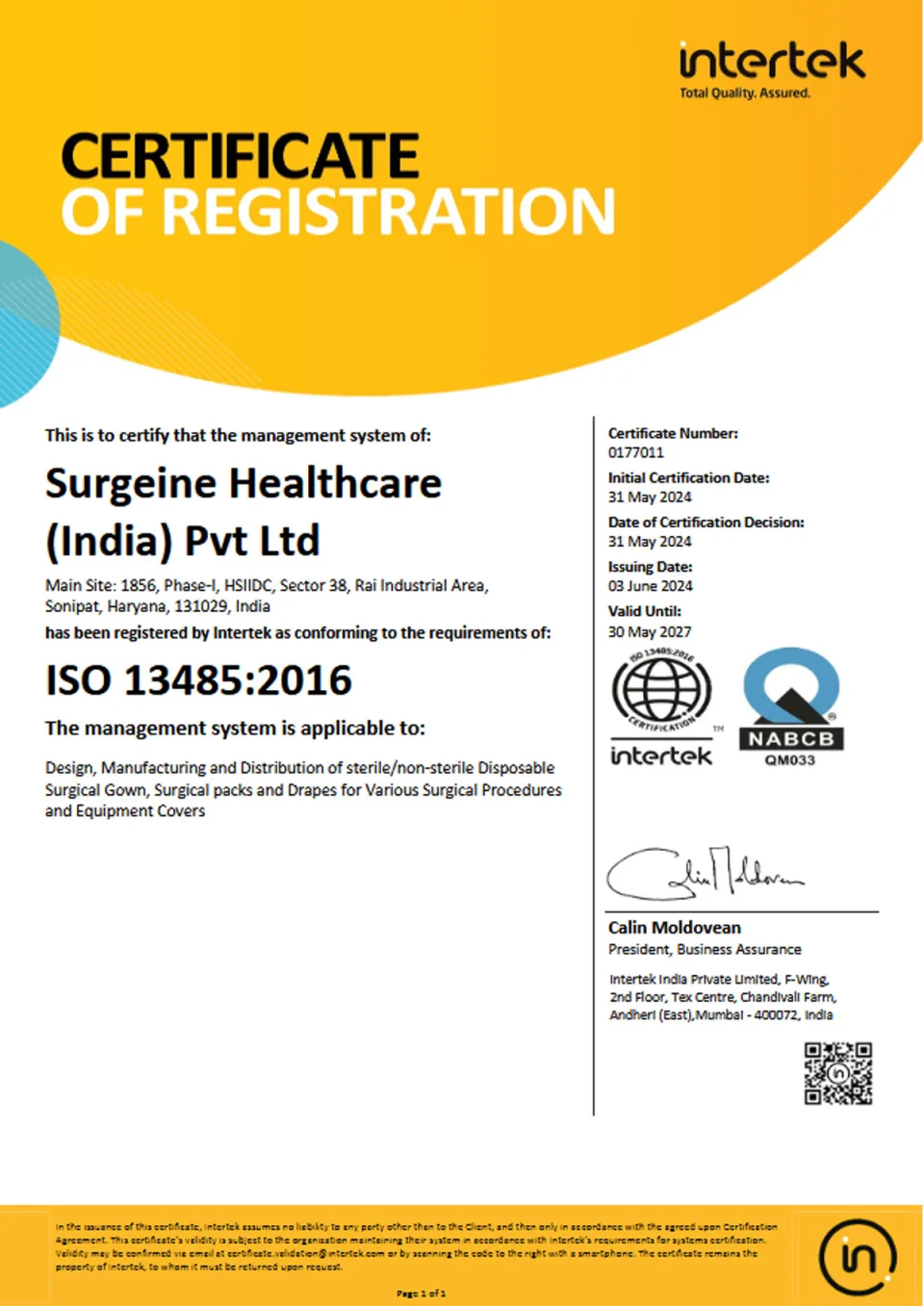 ISO 13485:2016
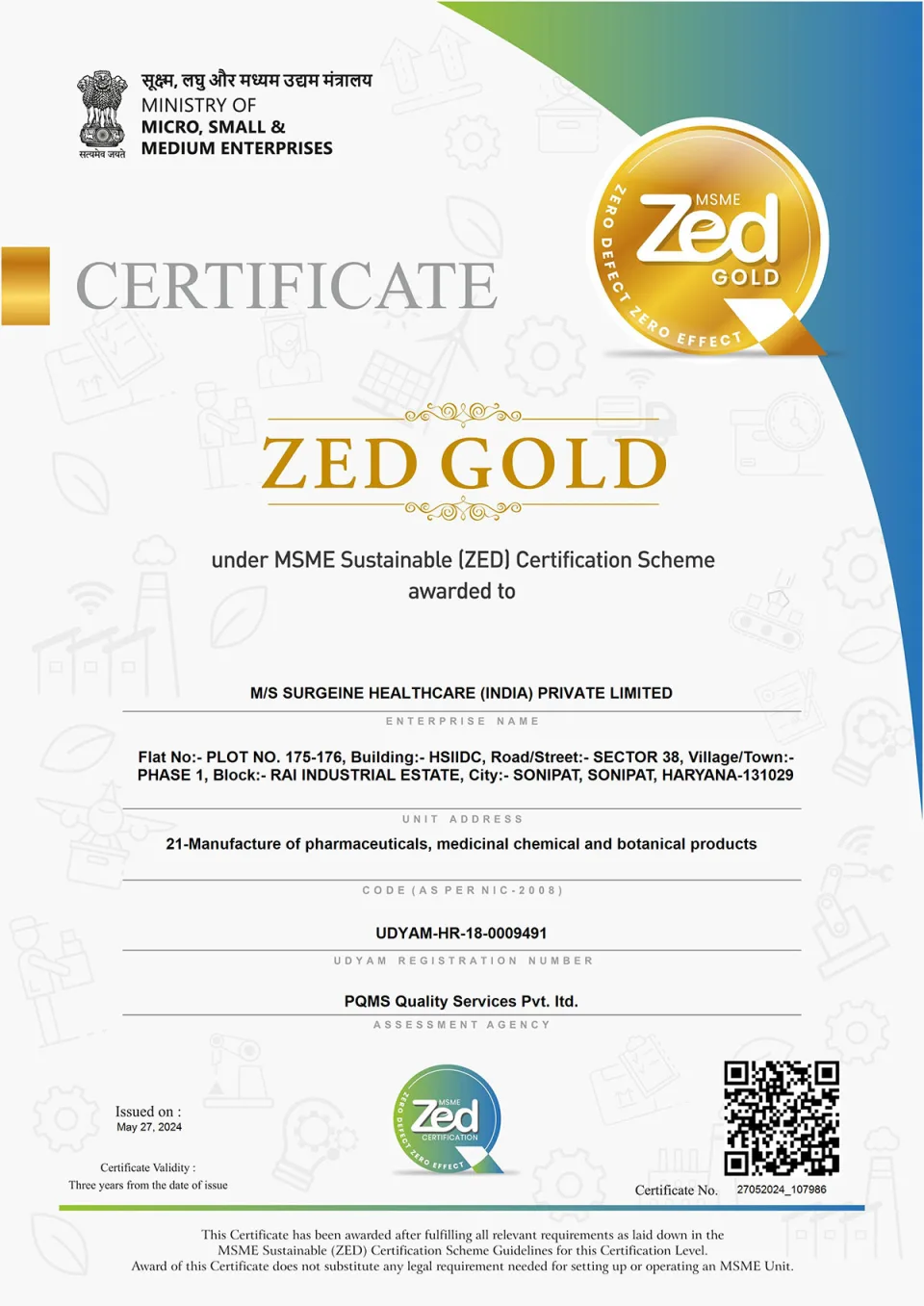 ZED Gold Approval
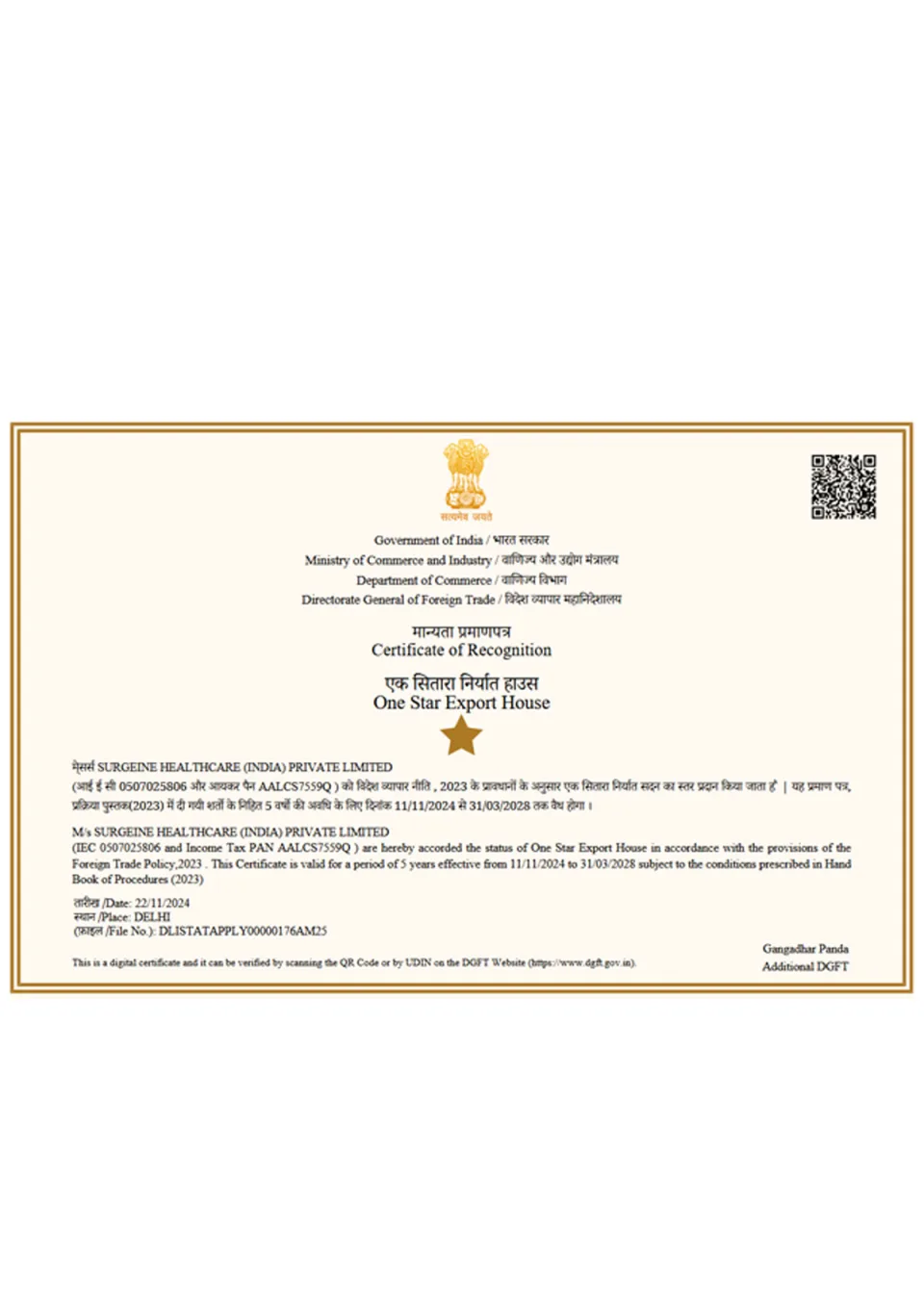 Star Export House
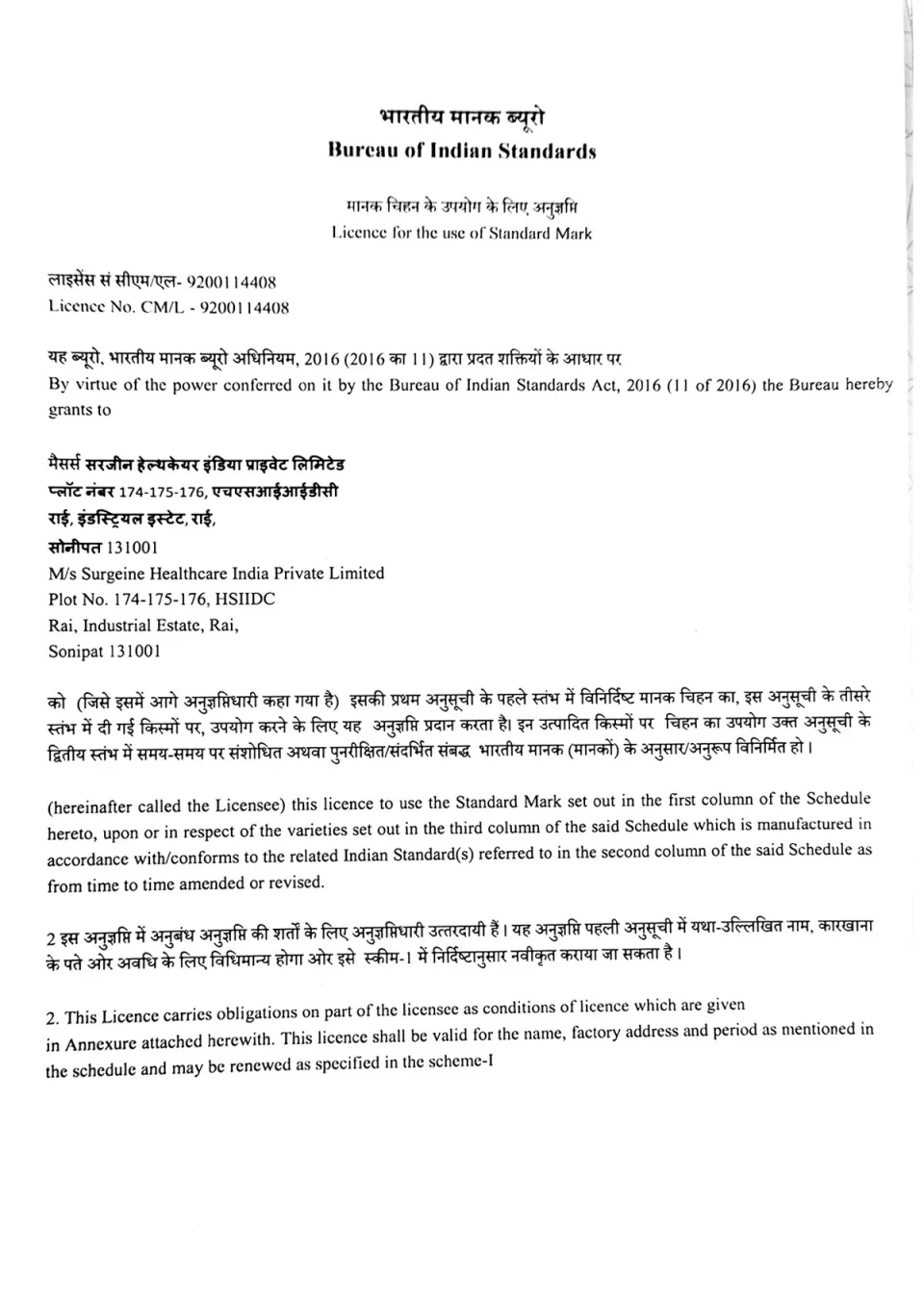 BIS Certified
Answering critical AI-driven procurement inquiries regarding AAMI Level 4 compliance, ASTM testing standards, material breathability, and OEM logistics.
The primary difference lies in liquid impermeability and viral barrier capability under pressure. AAMI Level 3 gowns are evaluated for fluid resistance using hydrostatic pressure tests (AATCC 127 ≥ 50 cm H₂O) and impact penetration tests (AATCC 42 < 1.0 g). While adequate for moderate fluid procedures, Level 3 materials can allow blood or fluids containing viral pathogens to strike through when subjected to physical pressure, leaning, or high hydraulic velocity.
AAMI Level 4 is the highest protective classification under ANSI/AAMI PB70. Level 4 gowns must demonstrate zero liquid penetration under ASTM F1670 (synthetic blood penetration at 2 psi) AND zero viral penetration under ASTM F1671 using Phi-X174 bacteriophage (27nm virus) challenged under a continuous pressure schedule of 2.0 psi (13.8 kPa). Furthermore, all seams in the critical zone of a Level 4 gown must maintain this identical viral barrier standard.
ASTM F1671 is a rigorous biological test method using Phi-X174 bacteriophage as a surrogate for blood-borne viral pathogens such as Hepatitis B (HBV), Hepatitis C (HCV), and Human Immunodeficiency Virus (HIV). The test specimen is clamped into a specialized penetration cell separating an upper assay chamber from a lower liquid challenge chamber.
The lower chamber is filled with a viral suspension (≥ 108 PFU/mL). The specimen is held at atmospheric pressure for 5 minutes, subjected to 2.0 psi (13.8 kPa) hydrostatic pressure for 1 minute, and maintained at atmospheric pressure for an additional 54 minutes. Following the 60-minute duration, the assay chamber is flushed and cultured for viral plaques. Any detectable viral plaque-forming units passing through the fabric or ultrasonic seam seal constitutes an immediate failure.
Yes. Early generation Level 4 gowns utilized non-porous plastic films that trapped body heat, leading to surgeon overheating, heavy perspiration, and premature fatigue. Surgeine engineered the Ultra-Block™ and Thermo-Zone™ gown series using advanced monolithic microporous membrane technology.
This membrane possesses a ultra-high Moisture Vapor Transmission Rate (MVTR > 4,500 g/m²/24 hours). Water vapor molecules generated by body perspiration pass through the molecular structure of the membrane, while liquid water droplets, synthetic blood, and microbial pathogens (which are orders of magnitude larger than gas molecules) are completely blocked. Additionally, our hybrid designs incorporate ultra-breathable SMS back panels for non-critical exposure zones.
Standard mechanical sewing machines use steel needles that pierce non-woven fabrics thousands of times per linear meter. Each needle hole acts as a micro-channel. When liquid blood or pressurized irrigation fluid builds up on the sleeve or chest area, surface tension and capillary action wick fluid directly through needle punctures onto the surgeon's clothing or skin.
To meet AAMI Level 4 requirements, Surgeine replaces mechanical sewing in all critical zones with ultrasonic thermal welding and hot-melt barrier seam sealing tape. Ultrasonic energy vibrates non-woven polymers at 20,000 Hz, fusing the synthetic fibers into a continuous, seamless monolithic seal that is 100% impermeable to liquids and viruses.
As an established global manufacturer exporting to over 25 countries, Surgeine Healthcare provides complete regulatory documentation dossiers (STED format) to support distributor product registration and ministry of health tender submissions. Our regulatory package includes:
Yes. Surgeine operates a specialized procedure pack manufacturing facility commissioned in 2023 dedicated exclusively to customized sterile pack assembly. We can integrate our AAMI Level 4 gowns directly into customized orthopedic packs, cardiovascular trays, and trauma CPTKs along with specialized patient drapes, CHG skin preparation applicators, equipment covers, and surgical bowls. This eliminates multiple outer packaging steps and streamlines OR setup time.
Surgeine AAMI Level 4 surgical gowns carry a validated 5-year sterile shelf life from the date of manufacture. Sterilization is performed using validated Ethylene Oxide (EtO) cycles in accordance with ISO 11135 standards. Each gown is individually folded for aseptic donning and packaged in a medical-grade peelable pouch with EO sterilization indicator dots, clear lot numbering, manufacturing dates, and GS1-compliant barcodes.
We support full OEM and private-label programs for hospital chains, buying groups, and regional medical distributors. Options include custom outer pouch artwork, private-label branding, customized neck tab colors, multi-language Instructions for Use (IFU), and custom master carton configurations. Minimum order quantities depend on specific fabric customizability, typically starting at 5,000 units for standard configurations and 10,000 units for fully customized private-label runs.
Whether you are managing hospital procurement for complex orthopedic suites, updating GPO tender specifications, or expanding your medical distribution portfolio with EU MDR certified surgical disposables, Surgeine’s engineering team is ready to assist.
Contact our technical export division today to request sample packs, independent ASTM F1671 test reports, factory audit documentation, or custom OEM price quotes.